
What Exactly Is Meditation and Why Has It Become So Popular in Cleveland?
Meditation has existed for thousands of years, but the reason it has surged in popularity today is simple: our brains are overloaded.
Modern life creates constant stimulation — screens, schedules, responsibilities, and stress — and meditation offers a rare chance to pause, recalibrate, and reconnect with yourself. It’s not about “emptying your mind” or achieving spiritual enlightenment. It’s about becoming aware of your thoughts without getting pulled into them.
Clients across Cleveland often discover meditation because they want:
- less stress
- better focus
- fewer racing thoughts
- more emotional balance
- improved sleep
- deeper self-understanding
Meditation is one of the most accessible tools for improving mental and emotional health — and it pairs exceptionally well with hypnotherapy.
What Is Meditation, Really? And What Happens in the Mind When You Practice It?
Meditation is a practice that trains your attention. At its core, it involves gently noticing what’s happening in the present moment — sensations, thoughts, feelings — without forcing anything or judging yourself for what shows up.
Meditation helps you build three essential skills:
- Awareness
Seeing your thoughts and feelings clearly. - Presence
Staying grounded in the here and now. - Non-reactivity
Responding intentionally rather than automatically.
When practiced regularly, meditation helps quiet mental noise and makes it easier to access states of calm focus — which is exactly why it pairs so naturally with hypnosis.
What Types of Meditation Do People Commonly Use
(and Which Work Best With Hypnosis)?
There’s no “right” type of meditation — each one offers something unique. In Cleveland, clients most often use:
Mindfulness Meditation
Noticing the present moment without judgment — great for reducing anxiety and improving emotional clarity.
Focused Attention Meditation
Using breath, sound, or sensation as an anchor — helpful for people who struggle with racing thoughts.
Mantra or Transcendental Meditation
Repeating a phrase to create calm and focus — excellent for relaxing the nervous system.
Guided Meditation
Listening to a narrator or practitioner — ideal for beginners or those who benefit from structure.
Movement Meditation
Slow, intentional movement such as walking or stretching — beneficial for people who feel restless.
Every one of these forms prepares the mind to respond even more effectively to hypnotherapy.
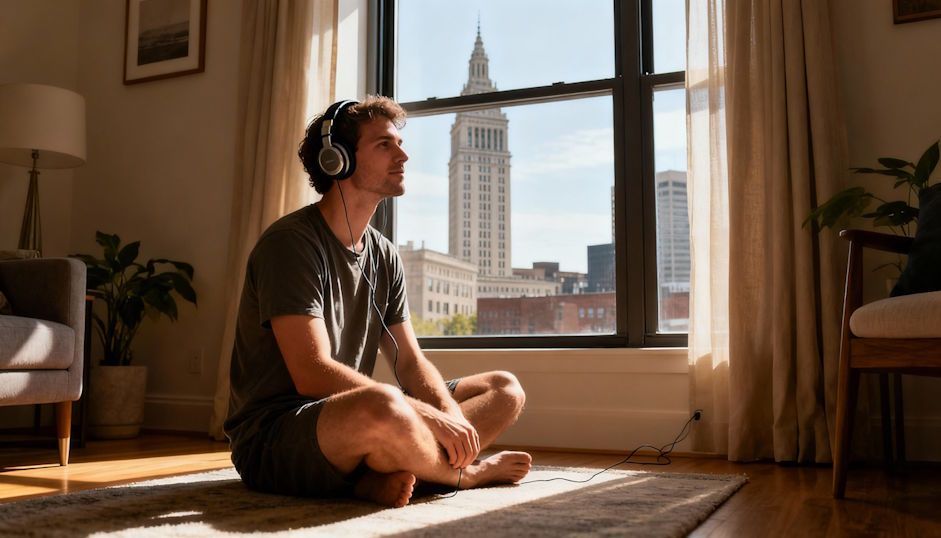
How Do You Actually Practice Meditation If You’re a Complete Beginner?
Many people believe meditation must be perfect or complicated. It isn’t. A simple practice is more effective than a long, forced one.
A beginner-friendly meditation routine might include:
- Find a quiet Cleveland corner: your couch, porch, car, or a park bench.
- Set a short time: even 3–5 minutes is enough.
- Sit comfortably: legs crossed, feet on floor, leaning back — whatever works.
- Choose a focus: your breath, a calming word, a soft sound.
- Let thoughts come and go: without trying to stop them.
- Gently return attention: again and again, without judging yourself.
Meditation isn’t about stopping thoughts — it’s about changing your relationship with them.
Why Is Meditation So Helpful for Stress, Sleep, Focus, and Emotional Health?
Meditation creates measurable changes in both the mind and body.
Research shows it can:
- lower stress hormones
- improve mood
- calm anxiety
- reduce blood pressure
- increase focus
- improve sleep
- strengthen emotional resilience
- support long-term mental health
Cleveland Clinic, Mayo Clinic, and the APA all acknowledge meditation as a powerful tool for wellness and recovery.
And when meditation becomes a habit, hypnotherapy tends to work even faster and more deeply.
What’s the Real Difference Between Meditation and Hypnosis?
Many people wonder whether meditation and hypnosis are the same. They’re similar — but they serve different purposes.
Meditation
Focuses on awareness, presence, and observing thoughts.
Hypnosis
Focuses on reprogramming subconscious patterns and creating change.
Meditation is like clearing the path.
Hypnosis is like paving a new one.
Both involve:
- calm focus
- reduced mental noise
- deep relaxation
- heightened awareness
But hypnosis uses this focused state to guide the mind toward specific goals — such as reducing anxiety, ending smoking, overcoming phobias, or building confidence.

How Exactly Do Meditation and Hypnotherapy Support Each Other?
When used together, these practices amplify each other’s impact.
Meditation improves your ability to relax quickly
This helps you enter hypnosis more easily.
Meditation strengthens focus
This increases hypnotic responsiveness.
Meditation reduces stress
Lower stress means faster therapeutic change.
Meditation improves emotional awareness
Hypnosis becomes more targeted and effective.
Meditation builds self-trust and self-understanding
This deepens the impact of hypnotic work.
Cleveland clients who meditate — even briefly — often report smoother, faster progress in hypnotherapy.
How Do Cleveland Clients Use Meditation Before, During, and After Hypnotherapy?
Here’s how people naturally integrate both:
Before Sessions
Meditation helps calm the mind so sessions start from a place of ease.
During Sessions
Meditation skills make it easier to settle into the hypnotic state, stay focused, and process internal changes.
After Sessions
Meditation reinforces new patterns and helps your mind integrate hypnotherapy suggestions more deeply.
Even 2–3 minutes of meditation a day can make a noticeable difference.
What Do the APA, Cleveland Clinic, and Mayo Clinic Say About Meditation and Hypnosis Together?
American Psychological Association (APA)
Acknowledges both meditation and hypnosis as evidence-based tools for reducing anxiety, stress, pain, and emotional dysregulation.
Cleveland Clinic
Recognizes meditation as a clinically beneficial technique and lists hypnotherapy as an effective tool for habit change, anxiety, pain, and stress relief.
Mayo Clinic
Supports meditation and hypnotherapy as complementary methods for improving mental and physical wellbeing.
When authoritative medical institutions highlight both practices, it strengthens the credibility and safety of integrating them.
How Do You Know If Meditation and Hypnotherapy Are Right for You?
You may benefit from combining both if you’re dealing with:
- anxiety
- panic
- PTSD
- phobias
- chronic stress
- sleep issues
- emotional eating
- smoking
- chronic worrying
- intrusive thoughts
- difficulty concentrating
- lack of motivation
Most clients don’t come because they’re “good at relaxing.”
They come because they want relief — and both practices offer that.
How Can You Begin Using Meditation Alongside Hypnotherapy?
You don’t need special equipment, experience, or long sessions.
A simple routine can be:
- 2 minutes in the morning
- 1–2 minutes before your hypnotherapy session
- 3 minutes before bed
Consistency matters more than perfection.
When meditation becomes a part of your daily rhythm, hypnotherapy goes deeper — and change becomes more natural.
What’s a Gentle Way to Begin Exploring Meditation and Hypnosis in Cleveland?
If you’re curious, here’s a simple approach:
- Start with a short, easy meditation.
- Notice how you feel — calmer, clearer, more grounded.
- Use that calmness to explore hypnotherapy as a next step.
- Let both practices support your emotional and mental wellbeing.
This isn’t about perfection — it’s about creating space for your mind to feel better.
📞 If you’d like to explore how meditation and hypnotherapy can support you together, click here to give us a call today!
Prefer a call-back?
Fill out this brief form
and we’ll reach out shortly.